
‘The people-to-people contact is the key for any bilateral process’
In the second panel of APRI Armenia and The Observer Research Foundation dialogue panelists discussed on the subject of Platforming a New Era of Geoeconomics: Technology, Energy, Connectivity.
- By Newsdesk
- New Delhi
- Feb 24, 2024
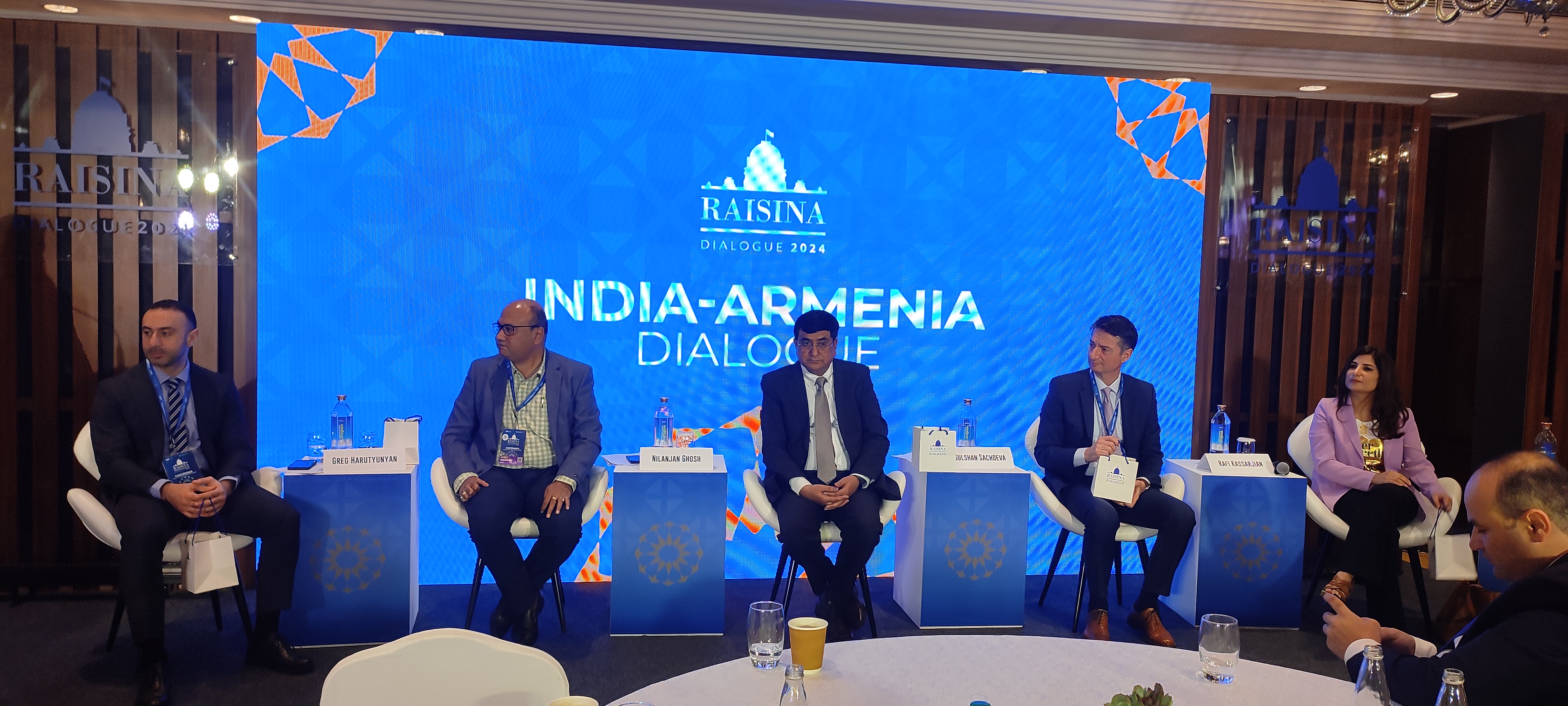
In the second panel of APRI Armenia and The Observer Research Foundation dialogue panelists discussed on the subject of Platforming a New Era of Geoeconomics: Technology, Energy, Connectivity.
Moderated by Shairee Malhotra, Europe Fellow, ORF the other panelists were - Rafi Kassarjian CEO, Sensyan, Anushavan Simonyan, Managing Partner, Amber Capital Armenia, Gulshan Sachdeva, Professor, Centre for European Studies, JNU and Nilanjan Ghosh, Director, Centre for New Economic Diplomacy and ORF Kolkata. From visionary projections to pragmatic strategies, the panel shed light on the dynamic potential of the burgeoning relationship between Armenia and India.
Rafi Kassarjian highlighted Armenia's emergence as a technological powerhouse, tracing its roots back to the Soviet era when it boasted a robust industrial base. With Armenia's expertise in chip design, AI, and dual-use technologies, Qasarjian stressed on the potential for collaboration between Indian and Armenian companies, particularly in leveraging Armenia's manufacturing capabilities and India's innovative tech solutions. “It is very important to note the concept of Armenia being the Silicon Valley of the former Soviet Union. It's worth mentioning that Armenia, the Armenian Soviet Republic, had more PhDs per capita than any of the other Soviet republics, including Russia, and that a significant portion of the technology, both in terms of software and in particular chip design, that fueled the Soviet Union's military capabilities, industrial capabilities, were developed in Armenia by Armenian scientists“, he said.
In a compelling address, Dr. Nilanjan Ghosh underscored the importance of initiatives like the International North-South Transport Corridor (INSTC) and the Armenian-led Crossroads of Peace project in facilitating trade and regional development. He quoted, “One of the key drivers when we talk about peace, this word happens to be this bit of economic diplomacy.The fact remains that India's economic diplomacy right now rests upon creating not merely transport corridors, but economic corridors.” Ghosh also highlighted the need for economic corridors to address trade barriers and reduce transaction costs, emphasizing the complementary demographic profiles of both nations as a potential driver for collaboration.
The discourse transcended theoretical frameworks, delving into practical avenues for collaboration. Anushavan Simonyan echoed the sentiments on trade, pointing to the increasing trade ties between India and Armenia. “The fact that Armenia is taking a presidency this year, that's just an added bonus for our relationship. However, if we speak about Armenia's role in this market, I would say that we would want to focus on economic corridors. So integrating Armenia as part of the value chain of Indian companies.” He emphasized the need for institutional cooperation to further boost trade and investment, particularly in leveraging Armenia's position within the Eurasian Economic Union and its potential as a manufacturing base for Indian companies seeking access to a $2.4 trillion market.
Advocating for People-to-People Ties, Professor Sachdeva highlighted the pivotal role of strengthening bilateral relations. He emphasized the need for institutional frameworks to facilitate exchanges in education, research, and entrepreneurship, citing the growing presence of Indian students in Armenia and the potential for university collaborations and joint research activities. “The people-to-people contact is basically the key for any bilateral process. There are two ways, actually, things that people-to-people contacts can be facilitated. One is by the market. And the second thing is, apart from markets, then you also have to create institutional frameworks. And the governments and the policy makers really have to facilitate those frameworks.”
Panelists also discussed the recent MOU signed between India and Armenia on digital cooperation, citing India's renowned digital public infrastructure as a model for collaboration. They identified areas such as artificial intelligence, digital infrastructure, and decision support systems as potential avenues for innovation and cooperation in the digital domain. With both nations recognizing the strategic importance of collaboration, the stage is set for deeper engagement and mutually beneficial partnerships in the years to come.